Those who know me know my attraction to the question of the origins of peoples. And more specifically, charity begins at home even one of my origins. As long as I can remember, I asked who I was, where I came through the patronymic, place names, genealogy. Today, more than two decades after the onset This disease obsessive, I am able to put words on a technical reality hardly palpable. Genetics! And I'm not crazy!
and I recently enjoyed a discount for buying the kit genetics company 23andMe California. The results fell within a few weeks of waiting, anxious too, because there is nothing more oppressive than the scientific determinism. From the standpoint of health, there is nothing to say, the American company has detected perfectly diseases "family". Basically, it boils down to obvious advice: avoid the disorderly life. This I am most interested in is what none of us has taken: the ancestral past.
Before anything else, here's a quick overview of my "pedigree" to weigh the results with guinea pigs tested:
- paternal side:
Grandfather: Bigourdan enclaves but the surname is Entre-Deux-Gaves in Béarn (probably migrating to 1800 that I can not prove through genealogical databases). Marriages between families of Béarn and Bigorre Saubole enclaves (Seron, Escaunets ...)
Grandmother: mother of Vic-Bihl (around Lembeye) with ancestors distant in Lower River. Father born in part from Protestant families Salies-de-Bearn and Catholics charnégous Labastide-Villefranche, on the border with the country of Gramont (Lower Navarre gasconophone).
- Maternal Side:
Grandfather: Morlaàs half-and half-Thèze.
Grandma: Morlaàs half-and half-Thèze. I suspect they were cousins because the same village back with obsession. :) ------------------------------
following results: To understand the technical terms, see the articles English Wikipedia that are well facts.
Y-DNA haplogroup :

haplogroup is a native Pyrenean frequently found among the Basques and the Catalans (ie among populations Basque-Iberian), which s' is subsequently extended to the whole of Europe after the Ice Age. There is nothing surprising about this result since the paternal line is probably located in the Entre-Deux-Gaves Bearn, Basque region in toponymy yet surreptitiously present. More specifically what the English Wikipedia says:
" This subclade is defined by the presence of the marker M167, also known as SRY2627. The first author to test for this marker (long before current haplogroup nomenclature existed) was Hurles in 1999, who tested 1158 men in various populations. He found it relatively common among Basques (13/117: 11%) and Catalans (7/32: 22%). Other occurrences were found among other English, Béarnais, other French, British and Germans.
In 2000 Rosser et al., in a study which tested 3616 men in various populations also tested for that same marker, naming the haplogroup Hg22, and again it was found mainly among Basques (19%), in lower frequencies among French (5%), Bavarians (3%), English (2%), Southern Portuguese (2%), and in single occurrences among Romanians, Slovenians, Dutch, Belgians and English.
In 2001 Bosch described this marker as H103, in 5 Basques and 5 Catalans. Further regional studies have located it in significant amounts in Asturias, Cantabria and Galicia, as well as again among Basques. Cases in the Azores and Latin America have also been reported. In 2008 two research papers by López-Parra and Adams, respectively, confirmed a strong Association with all gold Most Of The Eastern Pyrenees and Iberia. "
In 2000 Rosser et al., in a study which tested 3616 men in various populations also tested for that same marker, naming the haplogroup Hg22, and again it was found mainly among Basques (19%), in lower frequencies among French (5%), Bavarians (3%), English (2%), Southern Portuguese (2%), and in single occurrences among Romanians, Slovenians, Dutch, Belgians and English.
In 2001 Bosch described this marker as H103, in 5 Basques and 5 Catalans. Further regional studies have located it in significant amounts in Asturias, Cantabria and Galicia, as well as again among Basques. Cases in the Azores and Latin America have also been reported. In 2008 two research papers by López-Parra and Adams, respectively, confirmed a strong Association with all gold Most Of The Eastern Pyrenees and Iberia. "
mtDNA haplogroup :
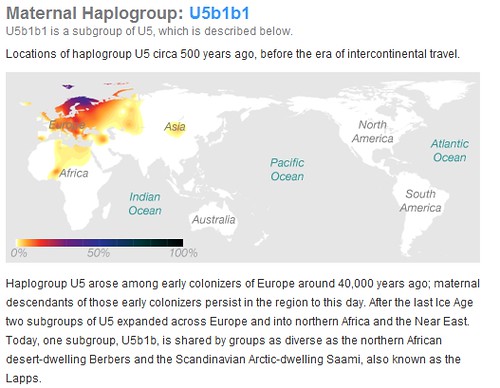
Haplogroup very rare in France is believed to be from the home of the Franco-Cantabrian Ice Age. He TODAY 'hui its maximum extension in Lapponi because of the repopulation of Europe after the ice age. Insofar as I look bad a retro-migration, it is highly likely that the presence of this haplogroup in the Pyrenees represents an initial state before its dispersion in the repopulation of Europe, including North. A small population with this haplogroup have been the ancestral source of much of northern Europeans: in fact, migration is more recent, less genetic variety is great. Even today, the SSA is the continent most genetically diverse. What Wiki says more precisely:
" Although a small proportion Of The Haplogroup U (mtDNA) Among the Sami falls U4 Into The Great Majority IS U5b. The Percentage of total Sami mtDNA samples Tested by Tambets and Her colleagues Which Were U5b Ranged from 56.8% in Nowegian to Sami 26.5% in Swedish Sami. Sami U5b falls into subclade U5b1b1. This subclade is present in the French, Croatian, Bosnian, Slovenian, Czech, Russian, Ukrainian, Polish, and Hungarian mtDNA pools and also in the Caucasus.
However 38% of the Sami U5b1b1 mtDNAs have haplotype so far exclusive to the Sami, containing a transition at np 16148. Alessandro Achilli and colleagues noted that the Sami and the Berbers share U5b1b, which they estimated at 9,000 years old, and argued that this provides evidence for a radiation of the haplogroup from the Franco-Cantabrian refuge area of southwestern Europe "
However 38% of the Sami U5b1b1 mtDNAs have haplotype so far exclusive to the Sami, containing a transition at np 16148. Alessandro Achilli and colleagues noted that the Sami and the Berbers share U5b1b, which they estimated at 9,000 years old, and argued that this provides evidence for a radiation of the haplogroup from the Franco-Cantabrian refuge area of southwestern Europe "
Ancestry painting:

Global similarity:
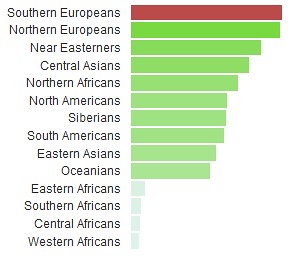
Southern European: 67.94
Northern European: 67.88
NB 23andme defines Southern Europe as Spain, Portugal, Italy, Basque sample ... more to them. France in its entirety is classified under the label cons' Europe North. "We will see in the cards after the artificiality of this division.
Europlot:
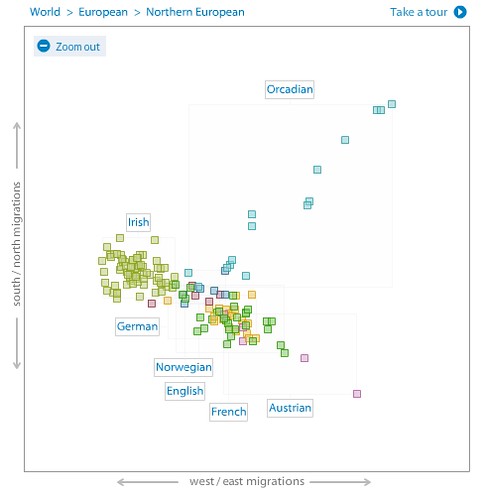
It is to situate the genome of users based on population base available 23andme: this is a stupid mathematical algorithm. I am the green arrow Basque isolation between the sample and the bulk of Europeans. The green squares represent a sample of Northern Europeans (the French are therefore included). Orange, southern Europeans (mostly Italians). I'm grosso modo, in fact, one third of distance from the Basque group and 2 / 3 of northern Europeans (except for the green box a bit absurd that approaches me on the right) as defined by 23andme. This means trivial in terms that genetically, it is the Basques that I am closest, well ahead of Northern Europeans, including the French.

DO pin: Zooming in on northern Europe, I do not appear on the chart because of variability outside the North European and defined.
SE pad: Zooming in on Southeast Europe, I do not appear on the chart because most outside the South-European variability as well defined.

I find myself so damn isolated, having no affinity narrow base with Europeans, who at least on an East / West migration are all located in the East (Neolithic contribution?). Plus it is located to the west, the more you are in contact with the European original home, now represented by the Basque people. This is the famous sanctuary "Franco-Cantabrian. What do you deduce that? I am genetically "Basque" but differently, in another variation, probably Aquitaine, who made the big transition with the Europeans. It's a safe bet that if 23andMe had samples of sub-populations such as the Pyrenean Upper Aragon, the Basque devices (Souletins, Roncal ...), The cadets in general and the Catalans, I would be less isolated and these people would provide the continuum of the graph.
Fortunately, 23andme can share with other users of its genetic data. So I added a lot of people that refine the graph.
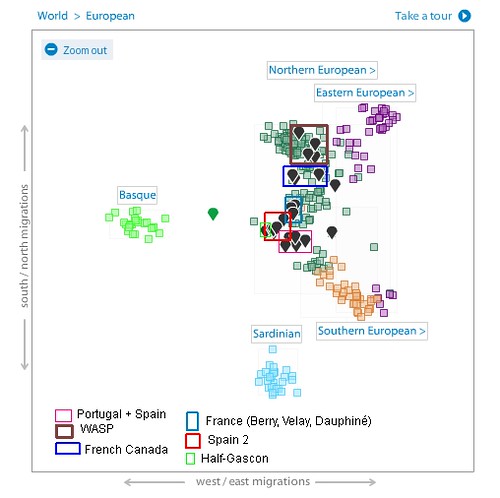
graph settles somewhat. Analyze the most interesting bands that appear:
- The group "Portugal + Spain" consists of two Portuguese users, one North and one from the South (which proves the homogeneity of the country) and Andalusians and a Manchego. We note that the Iberian group is in the north and west of the southern Europeans as defined by 23andme: the confirmation that the inhabitants of the Iberian Peninsula share a stronger affinity with the peoples of the Atlantic that 'with the Mediterranean. For now I did not understand what was this group of green squares "northern European" SE Iberian: These are samples of Provence by some who are so continuum with Italy.
- The French group is very interesting: from North to South, a user of the Berry / Bourbonnais, Velay another, then another of the Dauphiné (in its Part Occitan). So we see that these three individuals are approximately the same location on an axis from east to west.
- The group that currently comes closest to me on the axis from east to west is made up of Spaniards. The group is composed of an individual half-Aragonese, Valencian-half, another half Navarre Galician half, then a resident of Guadalajara ... my cousin who happens to be the 4th degree! Or do I have a English ancestor common with him, or one of my cousins in any branch will have migrated to Spain, France the classic pattern in the Southwest. In the NE corner of this group Catalan is an individual who is then transition to the French.
- Finally, note the individual says "Half-Gascon." 23andme tells me that this is an American whose mother was bearnaise around Salies-de-Bearn, so we cousinons by my ancestors in this area (she thought of Basque origin!). This lady is also 1 / 4 Corsica and 1 / 4 Austrian, the fact remains that it is one that tends most to me people add on, at least on the axis from east to west.
Conclusion:
Pending other results I will publish here is a conclusion Partial
- 23andme taught me nothing: I am "genetically" I am "genealogy". I am "Gascon" (Béarn), namely the modern avatar of the old ethnic aquitaine, including all evidence tending to prove that it is the extension of the ancient Basques in the north of the Pyrenees, between the Garonne The Ocean and the Pyrenees. I am a Latinized Basco-Aquitaine.
- My haplogroups are highly localized and relatively rare types, which confirms a very ancient land from my ancestors, that can be dated at least from the Ice Age.
- 23andme lack of samples Reference in small areas geographically fascinating but genetically, namely the old Basque-speaking countries: La Rioja, Upper Aragon, Gascony, Languedoc probably the Pyrenees. The sample chosen Basque is also known for its great originality as a result of inbreeding with the former world: therefore of the original genetic irreducible have developed (see the Sardinians).
We see very well that when one approaches the Franco-Cantabrian home, genetic distances are large, so that geographical distances are not. Two Portuguese 400km apart will be Side-by-side on the chart while two Basques are more distant, at least on the axis from east to west! The genetic variation is greater in the original home of Europe's population while many Europeans are the descendants of small groups of settlers left after the Ice Age, so genetically more homogeneous and more or less contact with subsequent Neolithic migrations from the Middle East.
continued!


0 comments:
Post a Comment