Nadau in setem
The dimenjada Passada, Eris au Cultura de Lescar tà crompà'm un libe espanhòu sus Aragon en l'estile de las guidas Gallimard, dab tèxtes un drin literaris. Que'm trobavi davant lo taulèr desdeishat de musica regionau quan a man esquèrra, aperceboi lo perhiu d'ua hilha agradiva, malament guastat per l'ombreta deu son òmi a pena sortit de l'atge ingrat. Que devisavan a perpaus d'un pialòt de CD, més en mustra a l'estrem deu men taulèr. Qu'èra miraclèr : joenòts captius davant la musica deu pèis, sasits per las represas deus Beatles per coralas bigordanas. Au bèth miei deus ventorruts vestits de terlís militars e deus fans de Johnny translatats de Lilla ençà, ua vision de gràcia : los Jausèp e Maria deu Biarn que vesiavan tendrament lo lor nin jos plastic. "Allez, je te l'achète". Ua grana emocion que'm harpeja : que'm tiri de cap au pialòt, P com Pagalhós, N com Nadau, A com Ardalh, ací qu'ei la causa charmanta, la qui sagerà l'union patriotica de dus joens biarnés. "Allez je te l'achète" : qu'èra aquiu, que i a ua minuta, lo son arridolet de hemnina, lo son poder de gojatet. E lo petit Jèsus que s'aperava Christophe Maé.
Thursday, September 30, 2010
Wednesday, September 22, 2010
Brent Everett 2010 Ver Online
Last Minute Act Aranese
En complément à ce que je pouvais indiquer, voici la suite des ingérences occitano-catalanes avec la loi sur l'aranais qui vient d'être adoptée. Propos intolérables de Carod-Rovira sur la loi who designates désormais "l'unité scientifique de la langue." It's unbearable and I que'n soi hart of aqueras maniganças.
Lien vers le site du Parlement de Catalogne
Lien vers le projet de loi adopté aujourd'hui
"The vice president of government, Josep-Lluis Carod-Rovira, presented the bill of Aran, which should ensure the "survival of the Occitan language" through the protection and guarantee of language rights and unity Aranese scientific language. For Carod, this is a "law of historical renewal to give an Occitan protection of which has never enjoyed. "vice president of government described the spider" living testimony of one of the great cultures emblematic of European construction ", and in this language, explained that the new legislation protects the speaks and gives guarantees do this in different areas.
Aranese law promotes and regulates the use and the official institutions, media, education and place names among others. The initiative fulfills the mandate of the statute that declares the official Occitan in Catalonia, called Aranese 'in Aran. The body, independent, who set the rules Studies Institute will Aranese.
Aranese law was approved by 117 votes (CIU, PSC-CPC, ERC, ICV-EUiA) and 17 against (PPC and mixed group). In the debate there were the deputies Carmen Vidal (CIU), the trustee of Aran, Francesc Boya (PSC-CPC), Maria Angeles Cabasés (ERC), Rafael Lopez (PPS), Francisco Pané (ICV-EUiA) and Carmen Rivera (mixed group). "
extrait du projet de loi du préambule:
" According to the tradition of language policy in Catalonia, this recognition includes the willingness to cooperate in protecting the unity of Occitan. Currently the most popular model of regulation, which maintains the same criteria Arans der spelling rules adopted by the Government of Catalonia in 1983, is defined by Lois Alibert in Occitan Grammar, published in Catalonia in 1935 and reissued by the Institute of Catalan Studies in 2000. Since the momentum of relations with other territories speaking Occitan Act can help to encourage the development of actions concerning the establishment and regulation guidelines Occitan.
Ajoutons également cette petition who circle, rédigée ainsi :
"Eth manifèst (...) inste ara Generalitat a convertir Aran, a trauèrs deth Conselh Generau e es sues institucions academiques, en “caplòc dera labor que se volgue amiar a tèrme ena Occitània de dehòra de Catalonha” entà “promòir era unificacion normativa der occitan” .
En complément à ce que je pouvais indiquer, voici la suite des ingérences occitano-catalanes avec la loi sur l'aranais qui vient d'être adoptée. Propos intolérables de Carod-Rovira sur la loi who designates désormais "l'unité scientifique de la langue." It's unbearable and I que'n soi hart of aqueras maniganças.
Lien vers le site du Parlement de Catalogne
Lien vers le projet de loi adopté aujourd'hui
"The vice president of government, Josep-Lluis Carod-Rovira, presented the bill of Aran, which should ensure the "survival of the Occitan language" through the protection and guarantee of language rights and unity Aranese scientific language. For Carod, this is a "law of historical renewal to give an Occitan protection of which has never enjoyed. "vice president of government described the spider" living testimony of one of the great cultures emblematic of European construction ", and in this language, explained that the new legislation protects the speaks and gives guarantees do this in different areas.
Aranese law promotes and regulates the use and the official institutions, media, education and place names among others. The initiative fulfills the mandate of the statute that declares the official Occitan in Catalonia, called Aranese 'in Aran. The body, independent, who set the rules Studies Institute will Aranese.
Aranese law was approved by 117 votes (CIU, PSC-CPC, ERC, ICV-EUiA) and 17 against (PPC and mixed group). In the debate there were the deputies Carmen Vidal (CIU), the trustee of Aran, Francesc Boya (PSC-CPC), Maria Angeles Cabasés (ERC), Rafael Lopez (PPS), Francisco Pané (ICV-EUiA) and Carmen Rivera (mixed group). "
extrait du projet de loi du préambule:
" According to the tradition of language policy in Catalonia, this recognition includes the willingness to cooperate in protecting the unity of Occitan. Currently the most popular model of regulation, which maintains the same criteria Arans der spelling rules adopted by the Government of Catalonia in 1983, is defined by Lois Alibert in Occitan Grammar, published in Catalonia in 1935 and reissued by the Institute of Catalan Studies in 2000. Since the momentum of relations with other territories speaking Occitan Act can help to encourage the development of actions concerning the establishment and regulation guidelines Occitan.
Ajoutons également cette petition who circle, rédigée ainsi :
"Eth manifèst (...) inste ara Generalitat a convertir Aran, a trauèrs deth Conselh Generau e es sues institucions academiques, en “caplòc dera labor que se volgue amiar a tèrme ena Occitània de dehòra de Catalonha” entà “promòir era unificacion normativa der occitan” .
Time Machine Kamehasutra
Reminder adopted the law
Le préfet des Pyrénées-Atlantiques a envoyé début septembre à tous les maires du département un rappel à la loi quant au régime d'aides qu'un conseil municipal peut allouer à des écoles privées, notamment du premier degré (en l'espèce les Ikastolak et les Calandretas). C'est la loi as codified in the Code of Education: to make fast, no capital expenditure but the community must bear the operating expenses. In practice, this involves the leasing of public premises at a rent lower than the rental value of new construction or for hosting a private school (first degree): a prohibition.
is the law. What does David Grosclaude then on " Ràdio País ? The warden did not take into account the entry * regional languages in the Constitution.
Grosclaude to seriously say that this changes all the legal problem. Really? First, it is the judge to say what is constitutional and what does not. A mayor has to attack the circular front of the prefect of the TA Pau, we'll see what the judges say with regard to this constitutional argument. One can seriously doubt that a policy statement on regional languages opposes the strict application of the scheme of private schools ... Especially more than one constitutional principles, are the principles of equality before the law and uniqueness of the French people who have served on other occasions to thwart any assertion of "regional language". New section 75-1 does not alter the primacy of the principle of indivisibility. I recalled the decision of the Constitutional Council on the Charter of regional languages:
In all cases, the law is the law, it was passed, it was not censored by the CC in its time, unless you ask a QPC on this issue, this is unnecessary. These are just posturing.
Basically, Grosclaude commits political struggle against the prefects. The prefect, however, is that the mouth of the law. The law is our members who vote. He is there to lead the political fight. It is ridiculous to attack the prefect who has no leeway. Worse, if the warden had said nothing, he would subject municipalities to legal uncertainty for a given bit is suing the aid (and here, the municipality can cough up, it can even destroy the frame ). This administered fussy (and unpleasant we hear) could even call into question the responsibility of the government through the figure of the prefect who has not taken action necessary.
In addition, the issue is deeper than that: it touches one of the pillars of France, namely the distrust of private education (although there was attenuation). It is highly regulated. What is therefore Grosclaude in a regional majority led by the PS? He does not know the position of parties in the traditional French Left on these issues? He ignores the Republican orthodoxy? Once again, an officer of Ikastola interviewed on the same radio has shown more political sense, saying "he had always been." On the one hand, people who know that is to lead the fight against some Republican doctrine and is therefore global. Other, policy inconsistency, an inconsistency in the commitment. Obviously he must "infiltrate" the party classic French to change the situation of the debate, but that was a long fight that requires an understanding of legal reasoning and policy of the "enemy".
Le préfet des Pyrénées-Atlantiques a envoyé début septembre à tous les maires du département un rappel à la loi quant au régime d'aides qu'un conseil municipal peut allouer à des écoles privées, notamment du premier degré (en l'espèce les Ikastolak et les Calandretas). C'est la loi as codified in the Code of Education: to make fast, no capital expenditure but the community must bear the operating expenses. In practice, this involves the leasing of public premises at a rent lower than the rental value of new construction or for hosting a private school (first degree): a prohibition.
is the law. What does David Grosclaude then on " Ràdio País ? The warden did not take into account the entry * regional languages in the Constitution.
*: "The regional languages are the patrimony of France. "
- Article 75-1 of the Constitution of October 4, 1958
Grosclaude to seriously say that this changes all the legal problem. Really? First, it is the judge to say what is constitutional and what does not. A mayor has to attack the circular front of the prefect of the TA Pau, we'll see what the judges say with regard to this constitutional argument. One can seriously doubt that a policy statement on regional languages opposes the strict application of the scheme of private schools ... Especially more than one constitutional principles, are the principles of equality before the law and uniqueness of the French people who have served on other occasions to thwart any assertion of "regional language". New section 75-1 does not alter the primacy of the principle of indivisibility. I recalled the decision of the Constitutional Council on the Charter of regional languages:
"It follows from these provisions that the combined Charter
European regional or minority languages, in that it
confers specific rights "groups" speakers of languages
regional or minority languages within the "territories" in
which these languages are spoken, violates the principles of constitutional
indivisibility of the Republic, equality before
law and uniqueness of the French people "
European regional or minority languages, in that it
confers specific rights "groups" speakers of languages
regional or minority languages within the "territories" in
which these languages are spoken, violates the principles of constitutional
indivisibility of the Republic, equality before
law and uniqueness of the French people "
In all cases, the law is the law, it was passed, it was not censored by the CC in its time, unless you ask a QPC on this issue, this is unnecessary. These are just posturing.
Basically, Grosclaude commits political struggle against the prefects. The prefect, however, is that the mouth of the law. The law is our members who vote. He is there to lead the political fight. It is ridiculous to attack the prefect who has no leeway. Worse, if the warden had said nothing, he would subject municipalities to legal uncertainty for a given bit is suing the aid (and here, the municipality can cough up, it can even destroy the frame ). This administered fussy (and unpleasant we hear) could even call into question the responsibility of the government through the figure of the prefect who has not taken action necessary.
In addition, the issue is deeper than that: it touches one of the pillars of France, namely the distrust of private education (although there was attenuation). It is highly regulated. What is therefore Grosclaude in a regional majority led by the PS? He does not know the position of parties in the traditional French Left on these issues? He ignores the Republican orthodoxy? Once again, an officer of Ikastola interviewed on the same radio has shown more political sense, saying "he had always been." On the one hand, people who know that is to lead the fight against some Republican doctrine and is therefore global. Other, policy inconsistency, an inconsistency in the commitment. Obviously he must "infiltrate" the party classic French to change the situation of the debate, but that was a long fight that requires an understanding of legal reasoning and policy of the "enemy".
Monday, September 20, 2010
Sympathy Message For Loss Of Mother
interference Catalan GLO
We know little but Occitanists reached a rather close link with the Generalitat de Catalunya through the "Grop of Lingüistica Occitane (GLO) * attached to the" Secretaria de Política Lingüística . The Aranese - complexed form device of Gascon - sont au premier plan de ce combat: il s'agit Occitan develop a standard. Non C'est sans honte that rhetoric utilisée est la plus minable pour ce faire endorse trick.
* "The contents of this minigramàtica of Occitan you have in your hands, prepared by Dr. Aitor Carrera, was approved by Grop Occitan Linguistics (GLO) of the Secretariat Language Policy of the Generalitat of Catalonia Vielha in the meeting on 7 February 2009. The GLO is composed by Dario Anghilante, Claudio Balaguer, Phillip Aitor Carrera, Jean-Claude Forest, Jep Montoya, Rosella Pellerino, Patrick Pojada, Mauritius Romieu, Patric Sauzet, Miquèu Segalàs, add Domergue, Jacme Taupiac Alan Viaut, Manel Zabala, and also Jean-Claude Rixte. The names of its members are quality assurance. "
" The forms are then exposed to a standard form of Occitan, input should be understandable without any prior learning-to-everyone know and use the language of oc, including Provence, Languedoc, alvernesos, Gascogne (Aranese included) or llemosins.
toute cette phrase cache Evidence that you will produce at standard fonction du Languedoc, ainsi que le Prouvé suite du document. Le GLO is deafend de toute ingérence, non sans faire dans le délire:
Lisez: quand le s'éclipsera the GLO will OCCITANIE Autonome ... Par la suite, the auteurs de ce document if the child mortality justifier plupart sont languedociens December choix, ce n'est that chance, that you will alliée cette langue standard from an "dialects".
Personally, I find this approach unacceptable both scientifically and politically. Scientifically because the normalizing process is biased because there is no reason to favor the Languedoc, which is nothing more central or more conservative than the other languages of oc, and in any case is certainly not the source, it does not seem to like the fact it is written with more seniority according to the codes alibertins.
Truth is that the Languedoc is a surévolution spoke Latin as the others, its centrality is a myth and its definition to make you smile (the Languedoc would be those dialects that do not vocalize). Strictly speaking, if one were truly unify says Occitan language should be like any self-respecting literary use of language history, namely the Limousin,
language of the troubadours, and certainly not the Languedoc, which announces the device variant Catalan in all Gallo-Roman southern anguedocien also dying off and in some regions (Aude, Hérault, ...).
Politically, the interference becomes Catalan heavy enough to bear but can not be accused of Catalonia. What is unbearable, it is this way Occitan parasitize institutions to make them say what they want. I can understand the need to reconnect with the Catalan Occitan called away to Madrid. But why come to dictate to people
foreign law these things? The Catalans have already destroyed the Roussillon, we see pretty much the same general trends of the steamroller normalizer Catalan. I even recently read texts Corominas who were so disappointed: I find you sources, but Corominas in his study of Aranese, expresses his opinion Aranese, if there Occitan is still "Catalan" and that in any case the people would have always felt Aranese "Catalan" and would have been in contempt Commingeois, the "French" (sic). What would not say small irredentist to make pretty maps ... These are the same people who will explain that the talk of Languedoc Fenouillèdes is in fact the Catalan "gabatxisé" or cut that will go in the transitional dialects in Aragon Catalonia shares.
importantly, what saddens me is that some sectors do not apply to the Catalan Occitan what they admit to their homes. Indeed, Catalonia has now clearly abandoned the ideal of Països Catalans. The vote on the bullfight is revealing in this regard because whatever one thinks, Barcelona accelerates the separation sentimental with Valencia. So on the one hand there are patriots who renounce the Catalan Grand Catalonia and prefer their stump independent feudal to a great action on all Catalan-speaking lands. Either. It is an approach IBGiste! And the other, those patriots in search of Catalan brothers north of the Pyrenees, we will come to speak Occitan, exploded assembly of small "Valencia", which is more differentiated elsewhere that Catalonia can not be the Valencia region. I think it's time for the Catalans to aim their true relationship across the Pyrenees, Languedoc know that at any point of view is twice northern Catalonia. Gascony could also revive the Catalonia via Midi-Pyrenees, perhaps. But then the Catalans that they can share with Provence, and especially with the so-called Occitan North is limited.
In any case, I have great sympathy for the Catalans but we can only be saddened that in order to do well, they extend into "Occitan" normalizing their obsession with the complicity of Occitanists known. I recall that the Catalan Parliament had voted a few months ago a resolution condemning the bottom of France for its attitude towards the people of Occitan. There have been diplomatic incidents for less than that. On the merits, it is quite fight against the emergence of this standard Occitan based Languedoc.
We know little but Occitanists reached a rather close link with the Generalitat de Catalunya through the "Grop of Lingüistica Occitane (GLO) * attached to the" Secretaria de Política Lingüística . The Aranese - complexed form device of Gascon - sont au premier plan de ce combat: il s'agit Occitan develop a standard. Non C'est sans honte that rhetoric utilisée est la plus minable pour ce faire endorse trick.
* "The contents of this minigramàtica of Occitan you have in your hands, prepared by Dr. Aitor Carrera, was approved by Grop Occitan Linguistics (GLO) of the Secretariat Language Policy of the Generalitat of Catalonia Vielha in the meeting on 7 February 2009. The GLO is composed by Dario Anghilante, Claudio Balaguer, Phillip Aitor Carrera, Jean-Claude Forest, Jep Montoya, Rosella Pellerino, Patrick Pojada, Mauritius Romieu, Patric Sauzet, Miquèu Segalàs, add Domergue, Jacme Taupiac Alan Viaut, Manel Zabala, and also Jean-Claude Rixte. The names of its members are quality assurance. "
" The forms are then exposed to a standard form of Occitan, input should be understandable without any prior learning-to-everyone know and use the language of oc, including Provence, Languedoc, alvernesos, Gascogne (Aranese included) or llemosins.
toute cette phrase cache Evidence that you will produce at standard fonction du Languedoc, ainsi que le Prouvé suite du document. Le GLO is deafend de toute ingérence, non sans faire dans le délire:
"The GLO, which advises the Secretariat of Linguistic Policy, is not intended nor
be the regulatory authority of the territory Occitan language. The
democratic structures of the same territory will generate this regulatory body.
On the existence of this authority's proposals are
GLO adapt. "
be the regulatory authority of the territory Occitan language. The
democratic structures of the same territory will generate this regulatory body.
On the existence of this authority's proposals are
GLO adapt. "
Lisez: quand le s'éclipsera the GLO will OCCITANIE Autonome ... Par la suite, the auteurs de ce document if the child mortality justifier plupart sont languedociens December choix, ce n'est that chance, that you will alliée cette langue standard from an "dialects".
"These forms are the product of a selection of items based on some linguistic criteria
seeking ways to encourage more widespread
diasistemàtiques or territory, or a more traditional historical and literary weight
more importantly, more regular, functional and autonomous or indigenous
Occitanian. There may be a more or less important match between these forms and, above all Alguns of the llenguadocians dialects, a situation en el domini del center Linguistics, però cal remarcar that Aquest fet no callus treure'n esbiaixades conclusions. "
seeking ways to encourage more widespread
diasistemàtiques or territory, or a more traditional historical and literary weight
more importantly, more regular, functional and autonomous or indigenous
Occitanian. There may be a more or less important match between these forms and, above all Alguns of the llenguadocians dialects, a situation en el domini del center Linguistics, però cal remarcar that Aquest fet no callus treure'n esbiaixades conclusions. "
Personally, I find this approach unacceptable both scientifically and politically. Scientifically because the normalizing process is biased because there is no reason to favor the Languedoc, which is nothing more central or more conservative than the other languages of oc, and in any case is certainly not the source, it does not seem to like the fact it is written with more seniority according to the codes alibertins.
Truth is that the Languedoc is a surévolution spoke Latin as the others, its centrality is a myth and its definition to make you smile (the Languedoc would be those dialects that do not vocalize). Strictly speaking, if one were truly unify says Occitan language should be like any self-respecting literary use of language history, namely the Limousin,
language of the troubadours, and certainly not the Languedoc, which announces the device variant Catalan in all Gallo-Roman southern anguedocien also dying off and in some regions (Aude, Hérault, ...).
Politically, the interference becomes Catalan heavy enough to bear but can not be accused of Catalonia. What is unbearable, it is this way Occitan parasitize institutions to make them say what they want. I can understand the need to reconnect with the Catalan Occitan called away to Madrid. But why come to dictate to people
foreign law these things? The Catalans have already destroyed the Roussillon, we see pretty much the same general trends of the steamroller normalizer Catalan. I even recently read texts Corominas who were so disappointed: I find you sources, but Corominas in his study of Aranese, expresses his opinion Aranese, if there Occitan is still "Catalan" and that in any case the people would have always felt Aranese "Catalan" and would have been in contempt Commingeois, the "French" (sic). What would not say small irredentist to make pretty maps ... These are the same people who will explain that the talk of Languedoc Fenouillèdes is in fact the Catalan "gabatxisé" or cut that will go in the transitional dialects in Aragon Catalonia shares.
importantly, what saddens me is that some sectors do not apply to the Catalan Occitan what they admit to their homes. Indeed, Catalonia has now clearly abandoned the ideal of Països Catalans. The vote on the bullfight is revealing in this regard because whatever one thinks, Barcelona accelerates the separation sentimental with Valencia. So on the one hand there are patriots who renounce the Catalan Grand Catalonia and prefer their stump independent feudal to a great action on all Catalan-speaking lands. Either. It is an approach IBGiste! And the other, those patriots in search of Catalan brothers north of the Pyrenees, we will come to speak Occitan, exploded assembly of small "Valencia", which is more differentiated elsewhere that Catalonia can not be the Valencia region. I think it's time for the Catalans to aim their true relationship across the Pyrenees, Languedoc know that at any point of view is twice northern Catalonia. Gascony could also revive the Catalonia via Midi-Pyrenees, perhaps. But then the Catalans that they can share with Provence, and especially with the so-called Occitan North is limited.
In any case, I have great sympathy for the Catalans but we can only be saddened that in order to do well, they extend into "Occitan" normalizing their obsession with the complicity of Occitanists known. I recall that the Catalan Parliament had voted a few months ago a resolution condemning the bottom of France for its attitude towards the people of Occitan. There have been diplomatic incidents for less than that. On the merits, it is quite fight against the emergence of this standard Occitan based Languedoc.
Monday, September 13, 2010
Schematics Homemade Vhf Balun Transformers
Our Open Day
Saturday, September 4, our Centre opened its doors to the public. From 11am, the first visitors joined us to participate in our program for the day. After a moment of very nice home with a cup of coffee and a piece of cake, the visits began.
The two firms, theaters spring and summer, were now occupied flowers for the occasion. The third room, the room winter, had been transformed by the addition of a bench and a dozen chairs, conference room.
At 12:30, lunch break well deserved. Enjoying the beautiful weather, we invested the garden of the property with table and chairs, and a well stocked buffet! What followed was a highlight of friendly exchange and discussion around a nice meal and some good wines Vaud.
The sweetness of the moment made us take our ease a bit, and it is with a little delay we started the program in the afternoon.
At 14:00, Carina was decided not to allow ourselves to take a nap, but lead us to focus on ourselves and our priorities. She guided us on an inner journey to find our own sense of ourselves and our environment. She made us aware of the difficulty we may have to connect us to our body, feelings, needs, and also our ability to be ignored when we connect them! A trip, very informative.
After a short break and welcoming new visitors, the program continued.
In 1530, Isabelle has trained us to discover the magic elixirs Bach flowers and floral. Once launched on his subject, she is unstoppable and no one knows the issue caught unprepared! She described the modes of action of flower essences in the work she does with patients concerned about wellness. She described the vibrational energy of these preparations and tried to make us perceive the strength through many descriptions. Then came
16.30, and almost time to leave!
To continue the journey began together, Carine and Isabella offered to interested visitors to leave their contact details to receive a free discovery session!
A final piece for the road, and our charming visitors greeted us!
|
| Carine and Isabella finally ready to welcome visitors! |
|
| Presentation of papers on flower essences |
|
| Presentation of papers on psycho-physical methods |
The two firms, theaters spring and summer, were now occupied flowers for the occasion. The third room, the room winter, had been transformed by the addition of a bench and a dozen chairs, conference room.
At 11:30, the first conference began with a presentation of Isabella on his approach to "act otherwise". Through a metaphor on "Aunt Bertha", she described several NLP techniques it uses to allow his patients to watch the events that happen to them, differently, with other "glasses". It has led us into an inner journey to discover our feelings face to this famous person who impresses us and led us to perceive the changes taking place in us as and when it changed in different visual, auditory sensations.
Carine succeeded him and led our group to approach the same subject.
At 12:30, lunch break well deserved. Enjoying the beautiful weather, we invested the garden of the property with table and chairs, and a well stocked buffet! What followed was a highlight of friendly exchange and discussion around a nice meal and some good wines Vaud.
The sweetness of the moment made us take our ease a bit, and it is with a little delay we started the program in the afternoon.
At 14:00, Carina was decided not to allow ourselves to take a nap, but lead us to focus on ourselves and our priorities. She guided us on an inner journey to find our own sense of ourselves and our environment. She made us aware of the difficulty we may have to connect us to our body, feelings, needs, and also our ability to be ignored when we connect them! A trip, very informative.
After a short break and welcoming new visitors, the program continued.
In 1530, Isabelle has trained us to discover the magic elixirs Bach flowers and floral. Once launched on his subject, she is unstoppable and no one knows the issue caught unprepared! She described the modes of action of flower essences in the work she does with patients concerned about wellness. She described the vibrational energy of these preparations and tried to make us perceive the strength through many descriptions. Then came
16.30, and almost time to leave!
To continue the journey began together, Carine and Isabella offered to interested visitors to leave their contact details to receive a free discovery session!
A final piece for the road, and our charming visitors greeted us!
We are grateful for the wonderful energy they brought to this day, and we look forward to seeing them again soon at one of our theme nights. A small seed is planted, wait and see what it will offer us ...
Sunday, September 12, 2010
Reg Für Mount And Blade
My results at the frontiers of genetic
Those who know me know my attraction to the question of the origins of peoples. And more specifically, charity begins at home even one of my origins. As long as I can remember, I asked who I was, where I came through the patronymic, place names, genealogy. Today, more than two decades after the onset This disease obsessive, I am able to put words on a technical reality hardly palpable. Genetics! And I'm not crazy!
and I recently enjoyed a discount for buying the kit genetics company 23andMe California. The results fell within a few weeks of waiting, anxious too, because there is nothing more oppressive than the scientific determinism. From the standpoint of health, there is nothing to say, the American company has detected perfectly diseases "family". Basically, it boils down to obvious advice: avoid the disorderly life. This I am most interested in is what none of us has taken: the ancestral past.
Before anything else, here's a quick overview of my "pedigree" to weigh the results with guinea pigs tested:
- paternal side:
Grandfather: Bigourdan enclaves but the surname is Entre-Deux-Gaves in Béarn (probably migrating to 1800 that I can not prove through genealogical databases). Marriages between families of Béarn and Bigorre Saubole enclaves (Seron, Escaunets ...)
Grandmother: mother of Vic-Bihl (around Lembeye) with ancestors distant in Lower River. Father born in part from Protestant families Salies-de-Bearn and Catholics charnégous Labastide-Villefranche, on the border with the country of Gramont (Lower Navarre gasconophone).
- Maternal Side:
Grandfather: Morlaàs half-and half-Thèze.
Grandma: Morlaàs half-and half-Thèze. I suspect they were cousins because the same village back with obsession. :) ------------------------------
following results: To understand the technical terms, see the articles English Wikipedia that are well facts.
Y-DNA haplogroup :
haplogroup is a native Pyrenean frequently found among the Basques and the Catalans (ie among populations Basque-Iberian), which s' is subsequently extended to the whole of Europe after the Ice Age. There is nothing surprising about this result since the paternal line is probably located in the Entre-Deux-Gaves Bearn, Basque region in toponymy yet surreptitiously present. More specifically what the English Wikipedia says:
mtDNA haplogroup :
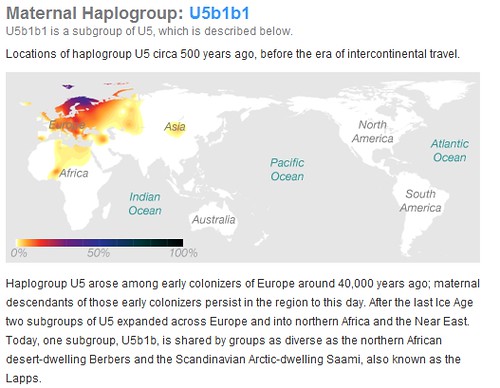
Haplogroup very rare in France is believed to be from the home of the Franco-Cantabrian Ice Age. He TODAY 'hui its maximum extension in Lapponi because of the repopulation of Europe after the ice age. Insofar as I look bad a retro-migration, it is highly likely that the presence of this haplogroup in the Pyrenees represents an initial state before its dispersion in the repopulation of Europe, including North. A small population with this haplogroup have been the ancestral source of much of northern Europeans: in fact, migration is more recent, less genetic variety is great. Even today, the SSA is the continent most genetically diverse. What Wiki says more precisely:
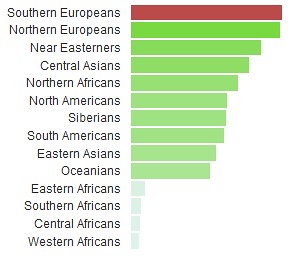
Ancestry painting:
Global similarity:
Southern European: 67.94
Northern European: 67.88
NB 23andme defines Southern Europe as Spain, Portugal, Italy, Basque sample ... more to them. France in its entirety is classified under the label cons' Europe North. "We will see in the cards after the artificiality of this division.
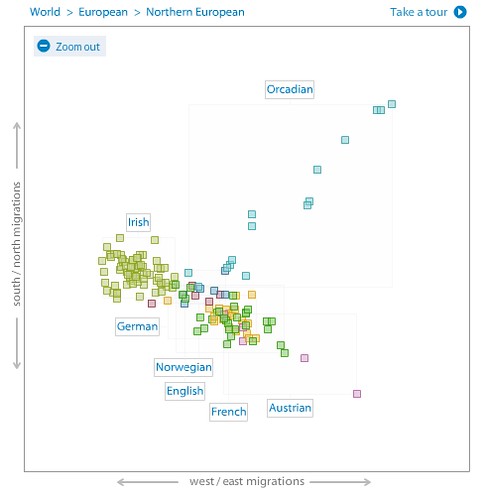
Europlot:
It is to situate the genome of users based on population base available 23andme: this is a stupid mathematical algorithm. I am the green arrow Basque isolation between the sample and the bulk of Europeans. The green squares represent a sample of Northern Europeans (the French are therefore included). Orange, southern Europeans (mostly Italians). I'm grosso modo, in fact, one third of distance from the Basque group and 2 / 3 of northern Europeans (except for the green box a bit absurd that approaches me on the right) as defined by 23andme. This means trivial in terms that genetically, it is the Basques that I am closest, well ahead of Northern Europeans, including the French.
DO pin: Zooming in on northern Europe, I do not appear on the chart because of variability outside the North European and defined.
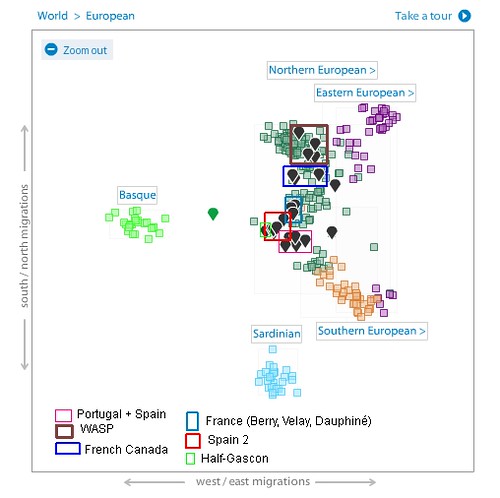
SE pad: Zooming in on Southeast Europe, I do not appear on the chart because most outside the South-European variability as well defined.
I find myself so damn isolated, having no affinity narrow base with Europeans, who at least on an East / West migration are all located in the East (Neolithic contribution?). Plus it is located to the west, the more you are in contact with the European original home, now represented by the Basque people. This is the famous sanctuary "Franco-Cantabrian. What do you deduce that? I am genetically "Basque" but differently, in another variation, probably Aquitaine, who made the big transition with the Europeans. It's a safe bet that if 23andMe had samples of sub-populations such as the Pyrenean Upper Aragon, the Basque devices (Souletins, Roncal ...), The cadets in general and the Catalans, I would be less isolated and these people would provide the continuum of the graph.
Fortunately, 23andme can share with other users of its genetic data. So I added a lot of people that refine the graph.
graph settles somewhat. Analyze the most interesting bands that appear:
- The group "Portugal + Spain" consists of two Portuguese users, one North and one from the South (which proves the homogeneity of the country) and Andalusians and a Manchego. We note that the Iberian group is in the north and west of the southern Europeans as defined by 23andme: the confirmation that the inhabitants of the Iberian Peninsula share a stronger affinity with the peoples of the Atlantic that 'with the Mediterranean. For now I did not understand what was this group of green squares "northern European" SE Iberian: These are samples of Provence by some who are so continuum with Italy.
- The French group is very interesting: from North to South, a user of the Berry / Bourbonnais, Velay another, then another of the Dauphiné (in its Part Occitan). So we see that these three individuals are approximately the same location on an axis from east to west.
- The group that currently comes closest to me on the axis from east to west is made up of Spaniards. The group is composed of an individual half-Aragonese, Valencian-half, another half Navarre Galician half, then a resident of Guadalajara ... my cousin who happens to be the 4th degree! Or do I have a English ancestor common with him, or one of my cousins in any branch will have migrated to Spain, France the classic pattern in the Southwest. In the NE corner of this group Catalan is an individual who is then transition to the French.
- Finally, note the individual says "Half-Gascon." 23andme tells me that this is an American whose mother was bearnaise around Salies-de-Bearn, so we cousinons by my ancestors in this area (she thought of Basque origin!). This lady is also 1 / 4 Corsica and 1 / 4 Austrian, the fact remains that it is one that tends most to me people add on, at least on the axis from east to west.
Conclusion:
Pending other results I will publish here is a conclusion Partial
- 23andme taught me nothing: I am "genetically" I am "genealogy". I am "Gascon" (Béarn), namely the modern avatar of the old ethnic aquitaine, including all evidence tending to prove that it is the extension of the ancient Basques in the north of the Pyrenees, between the Garonne The Ocean and the Pyrenees. I am a Latinized Basco-Aquitaine.
- My haplogroups are highly localized and relatively rare types, which confirms a very ancient land from my ancestors, that can be dated at least from the Ice Age.
- 23andme lack of samples Reference in small areas geographically fascinating but genetically, namely the old Basque-speaking countries: La Rioja, Upper Aragon, Gascony, Languedoc probably the Pyrenees. The sample chosen Basque is also known for its great originality as a result of inbreeding with the former world: therefore of the original genetic irreducible have developed (see the Sardinians).
We see very well that when one approaches the Franco-Cantabrian home, genetic distances are large, so that geographical distances are not. Two Portuguese 400km apart will be Side-by-side on the chart while two Basques are more distant, at least on the axis from east to west! The genetic variation is greater in the original home of Europe's population while many Europeans are the descendants of small groups of settlers left after the Ice Age, so genetically more homogeneous and more or less contact with subsequent Neolithic migrations from the Middle East.
continued!
Those who know me know my attraction to the question of the origins of peoples. And more specifically, charity begins at home even one of my origins. As long as I can remember, I asked who I was, where I came through the patronymic, place names, genealogy. Today, more than two decades after the onset This disease obsessive, I am able to put words on a technical reality hardly palpable. Genetics! And I'm not crazy!
and I recently enjoyed a discount for buying the kit genetics company 23andMe California. The results fell within a few weeks of waiting, anxious too, because there is nothing more oppressive than the scientific determinism. From the standpoint of health, there is nothing to say, the American company has detected perfectly diseases "family". Basically, it boils down to obvious advice: avoid the disorderly life. This I am most interested in is what none of us has taken: the ancestral past.
Before anything else, here's a quick overview of my "pedigree" to weigh the results with guinea pigs tested:
- paternal side:
Grandfather: Bigourdan enclaves but the surname is Entre-Deux-Gaves in Béarn (probably migrating to 1800 that I can not prove through genealogical databases). Marriages between families of Béarn and Bigorre Saubole enclaves (Seron, Escaunets ...)
Grandmother: mother of Vic-Bihl (around Lembeye) with ancestors distant in Lower River. Father born in part from Protestant families Salies-de-Bearn and Catholics charnégous Labastide-Villefranche, on the border with the country of Gramont (Lower Navarre gasconophone).
- Maternal Side:
Grandfather: Morlaàs half-and half-Thèze.
Grandma: Morlaàs half-and half-Thèze. I suspect they were cousins because the same village back with obsession. :) ------------------------------
following results: To understand the technical terms, see the articles English Wikipedia that are well facts.
Y-DNA haplogroup :
haplogroup is a native Pyrenean frequently found among the Basques and the Catalans (ie among populations Basque-Iberian), which s' is subsequently extended to the whole of Europe after the Ice Age. There is nothing surprising about this result since the paternal line is probably located in the Entre-Deux-Gaves Bearn, Basque region in toponymy yet surreptitiously present. More specifically what the English Wikipedia says:
" This subclade is defined by the presence of the marker M167, also known as SRY2627. The first author to test for this marker (long before current haplogroup nomenclature existed) was Hurles in 1999, who tested 1158 men in various populations. He found it relatively common among Basques (13/117: 11%) and Catalans (7/32: 22%). Other occurrences were found among other English, Béarnais, other French, British and Germans.
In 2000 Rosser et al., in a study which tested 3616 men in various populations also tested for that same marker, naming the haplogroup Hg22, and again it was found mainly among Basques (19%), in lower frequencies among French (5%), Bavarians (3%), English (2%), Southern Portuguese (2%), and in single occurrences among Romanians, Slovenians, Dutch, Belgians and English.
In 2001 Bosch described this marker as H103, in 5 Basques and 5 Catalans. Further regional studies have located it in significant amounts in Asturias, Cantabria and Galicia, as well as again among Basques. Cases in the Azores and Latin America have also been reported. In 2008 two research papers by López-Parra and Adams, respectively, confirmed a strong Association with all gold Most Of The Eastern Pyrenees and Iberia. "
In 2000 Rosser et al., in a study which tested 3616 men in various populations also tested for that same marker, naming the haplogroup Hg22, and again it was found mainly among Basques (19%), in lower frequencies among French (5%), Bavarians (3%), English (2%), Southern Portuguese (2%), and in single occurrences among Romanians, Slovenians, Dutch, Belgians and English.
In 2001 Bosch described this marker as H103, in 5 Basques and 5 Catalans. Further regional studies have located it in significant amounts in Asturias, Cantabria and Galicia, as well as again among Basques. Cases in the Azores and Latin America have also been reported. In 2008 two research papers by López-Parra and Adams, respectively, confirmed a strong Association with all gold Most Of The Eastern Pyrenees and Iberia. "
mtDNA haplogroup :
Haplogroup very rare in France is believed to be from the home of the Franco-Cantabrian Ice Age. He TODAY 'hui its maximum extension in Lapponi because of the repopulation of Europe after the ice age. Insofar as I look bad a retro-migration, it is highly likely that the presence of this haplogroup in the Pyrenees represents an initial state before its dispersion in the repopulation of Europe, including North. A small population with this haplogroup have been the ancestral source of much of northern Europeans: in fact, migration is more recent, less genetic variety is great. Even today, the SSA is the continent most genetically diverse. What Wiki says more precisely:
" Although a small proportion Of The Haplogroup U (mtDNA) Among the Sami falls U4 Into The Great Majority IS U5b. The Percentage of total Sami mtDNA samples Tested by Tambets and Her colleagues Which Were U5b Ranged from 56.8% in Nowegian to Sami 26.5% in Swedish Sami. Sami U5b falls into subclade U5b1b1. This subclade is present in the French, Croatian, Bosnian, Slovenian, Czech, Russian, Ukrainian, Polish, and Hungarian mtDNA pools and also in the Caucasus.
However 38% of the Sami U5b1b1 mtDNAs have haplotype so far exclusive to the Sami, containing a transition at np 16148. Alessandro Achilli and colleagues noted that the Sami and the Berbers share U5b1b, which they estimated at 9,000 years old, and argued that this provides evidence for a radiation of the haplogroup from the Franco-Cantabrian refuge area of southwestern Europe "
Ancestry painting:
Global similarity:
Southern European: 67.94
Northern European: 67.88
NB 23andme defines Southern Europe as Spain, Portugal, Italy, Basque sample ... more to them. France in its entirety is classified under the label cons' Europe North. "We will see in the cards after the artificiality of this division.
Europlot:
It is to situate the genome of users based on population base available 23andme: this is a stupid mathematical algorithm. I am the green arrow Basque isolation between the sample and the bulk of Europeans. The green squares represent a sample of Northern Europeans (the French are therefore included). Orange, southern Europeans (mostly Italians). I'm grosso modo, in fact, one third of distance from the Basque group and 2 / 3 of northern Europeans (except for the green box a bit absurd that approaches me on the right) as defined by 23andme. This means trivial in terms that genetically, it is the Basques that I am closest, well ahead of Northern Europeans, including the French.
DO pin: Zooming in on northern Europe, I do not appear on the chart because of variability outside the North European and defined.
SE pad: Zooming in on Southeast Europe, I do not appear on the chart because most outside the South-European variability as well defined.
I find myself so damn isolated, having no affinity narrow base with Europeans, who at least on an East / West migration are all located in the East (Neolithic contribution?). Plus it is located to the west, the more you are in contact with the European original home, now represented by the Basque people. This is the famous sanctuary "Franco-Cantabrian. What do you deduce that? I am genetically "Basque" but differently, in another variation, probably Aquitaine, who made the big transition with the Europeans. It's a safe bet that if 23andMe had samples of sub-populations such as the Pyrenean Upper Aragon, the Basque devices (Souletins, Roncal ...), The cadets in general and the Catalans, I would be less isolated and these people would provide the continuum of the graph.
Fortunately, 23andme can share with other users of its genetic data. So I added a lot of people that refine the graph.
graph settles somewhat. Analyze the most interesting bands that appear:
- The group "Portugal + Spain" consists of two Portuguese users, one North and one from the South (which proves the homogeneity of the country) and Andalusians and a Manchego. We note that the Iberian group is in the north and west of the southern Europeans as defined by 23andme: the confirmation that the inhabitants of the Iberian Peninsula share a stronger affinity with the peoples of the Atlantic that 'with the Mediterranean. For now I did not understand what was this group of green squares "northern European" SE Iberian: These are samples of Provence by some who are so continuum with Italy.
- The French group is very interesting: from North to South, a user of the Berry / Bourbonnais, Velay another, then another of the Dauphiné (in its Part Occitan). So we see that these three individuals are approximately the same location on an axis from east to west.
- The group that currently comes closest to me on the axis from east to west is made up of Spaniards. The group is composed of an individual half-Aragonese, Valencian-half, another half Navarre Galician half, then a resident of Guadalajara ... my cousin who happens to be the 4th degree! Or do I have a English ancestor common with him, or one of my cousins in any branch will have migrated to Spain, France the classic pattern in the Southwest. In the NE corner of this group Catalan is an individual who is then transition to the French.
- Finally, note the individual says "Half-Gascon." 23andme tells me that this is an American whose mother was bearnaise around Salies-de-Bearn, so we cousinons by my ancestors in this area (she thought of Basque origin!). This lady is also 1 / 4 Corsica and 1 / 4 Austrian, the fact remains that it is one that tends most to me people add on, at least on the axis from east to west.
Conclusion:
Pending other results I will publish here is a conclusion Partial
- 23andme taught me nothing: I am "genetically" I am "genealogy". I am "Gascon" (Béarn), namely the modern avatar of the old ethnic aquitaine, including all evidence tending to prove that it is the extension of the ancient Basques in the north of the Pyrenees, between the Garonne The Ocean and the Pyrenees. I am a Latinized Basco-Aquitaine.
- My haplogroups are highly localized and relatively rare types, which confirms a very ancient land from my ancestors, that can be dated at least from the Ice Age.
- 23andme lack of samples Reference in small areas geographically fascinating but genetically, namely the old Basque-speaking countries: La Rioja, Upper Aragon, Gascony, Languedoc probably the Pyrenees. The sample chosen Basque is also known for its great originality as a result of inbreeding with the former world: therefore of the original genetic irreducible have developed (see the Sardinians).
We see very well that when one approaches the Franco-Cantabrian home, genetic distances are large, so that geographical distances are not. Two Portuguese 400km apart will be Side-by-side on the chart while two Basques are more distant, at least on the axis from east to west! The genetic variation is greater in the original home of Europe's population while many Europeans are the descendants of small groups of settlers left after the Ice Age, so genetically more homogeneous and more or less contact with subsequent Neolithic migrations from the Middle East.
continued!
Wednesday, September 8, 2010
Films With Men And Wemen In Girdles
Gascon Gascon Cherbeys
We are in the small village of Charre, right bank of the season, in Béarn, in the hamlet of Cherbeys.
Cherbeys is Xerbee-Jusoo High in 1385. The addition of an s ( Cherbi the nineteenth century) is quite mysterious as in the nearby hamlet of Bisqueys (the Basque Bizkit, rated Biscay on the Cassini map), unless either of a plural to refer to that yet Susoo Xerbee-Paul Raymond does not identify Xerbee-Jusoo. It seems that as certified in 1386 called simply Xerbe.
In the enumeration of fires in 1385, X is used to record a hissing, often from the apico-alveolar s Gascon (eg Guixarnaut, after Gassie-Arnaut), common to Castilian (the famous English hisses s), but not necessarily.
We think immediately Gascon "Gerber" which was rather Yerbee however, because in Bearn, g + i, e it gives, perhaps formerly j, but never a hissing (this is the case in Aragon). "Serbian" does nothing about it.
Then, in the context of the presence of Basque in the village again in the fourteenth century as confirmed by the domonymie of the time, one can imagine it is the deformation of the Basque Etxeberri:
should know the current pronunciation is the emphasis on the initial is often a clue, but it has been lost. A Charre, in 1385, Basque Etxebertze * gave the house called Cheverce . The problem is therefore in the same village at the same time, there Cheverce one hand with "ch" (affricate? In modern Basque: "tx") and Xerbee with "x" (single Chuit in modern Basque, between "x" and "s").
Certainly in Gascony, "etxe" is ultimately interpreted sibilant (see Xandir Sauvelade at the same time which can only Etxehandia).
But why this difference? It is true that for example, the Basque town of Charritte-de-Haut, an entry in the Censier Gothic exartea "Etxartea and" Echeverri "Etxeberria.
*: Bertz in Basque is "other." "The other house." "Lautecaze" exists in Gascon.
Anecdotally, in the Gothic Censier Soule, when the name of Basque houses is transparent, it is translated in Gascon. The vast majority of Etxegapare / Etxekapare is called "casemayor.
We are in the small village of Charre, right bank of the season, in Béarn, in the hamlet of Cherbeys.
Cherbeys is Xerbee-Jusoo High in 1385. The addition of an s ( Cherbi the nineteenth century) is quite mysterious as in the nearby hamlet of Bisqueys (the Basque Bizkit, rated Biscay on the Cassini map), unless either of a plural to refer to that yet Susoo Xerbee-Paul Raymond does not identify Xerbee-Jusoo. It seems that as certified in 1386 called simply Xerbe.
In the enumeration of fires in 1385, X is used to record a hissing, often from the apico-alveolar s Gascon (eg Guixarnaut, after Gassie-Arnaut), common to Castilian (the famous English hisses s), but not necessarily.
We think immediately Gascon "Gerber" which was rather Yerbee however, because in Bearn, g + i, e it gives, perhaps formerly j, but never a hissing (this is the case in Aragon). "Serbian" does nothing about it.
Then, in the context of the presence of Basque in the village again in the fourteenth century as confirmed by the domonymie of the time, one can imagine it is the deformation of the Basque Etxeberri:
(And) xeberri> 'Cheberri> Cherbi (metathesis Gascon)
should know the current pronunciation is the emphasis on the initial is often a clue, but it has been lost. A Charre, in 1385, Basque Etxebertze * gave the house called Cheverce . The problem is therefore in the same village at the same time, there Cheverce one hand with "ch" (affricate? In modern Basque: "tx") and Xerbee with "x" (single Chuit in modern Basque, between "x" and "s").
Certainly in Gascony, "etxe" is ultimately interpreted sibilant (see Xandir Sauvelade at the same time which can only Etxehandia).
But why this difference? It is true that for example, the Basque town of Charritte-de-Haut, an entry in the Censier Gothic exartea "Etxartea and" Echeverri "Etxeberria.
*: Bertz in Basque is "other." "The other house." "Lautecaze" exists in Gascon.
Anecdotally, in the Gothic Censier Soule, when the name of Basque houses is transparent, it is translated in Gascon. The vast majority of Etxegapare / Etxekapare is called "casemayor.
Sims 2 Very Big Belly
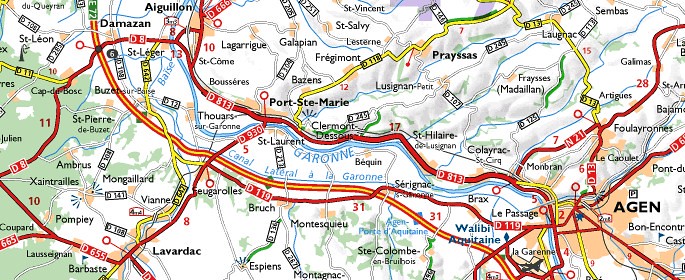
and Guyenne in the Lot-et-Garonne The
| ||
| | | |
What Is The Girth Of A Toilet Paper Roll
Gascon in the geography of the nineteenth century
"The Iberian family, which in antiquity were composed of the Iberians, who lived
Spain, Portugal and the Gascuña [...] In Aquitaine he
day purebred de los Iberos soil comprises the Basques; Check
English and Portuguese come from Los Antiguos Iberos amalgamated
with the Gauls, Romans, Goths and Arabs. The Iberians are
Gascon afrancesados. "
Elementary course of physical geography, politics and astronomy, Bernardo Monreal and Ascaso, 1863 --------
" Les sont des Iberians Gascons Roma. Les Béarnais parmi eux ont toujours occup premier rang him. "
Second cours de géographie, Constant Frederic de Rougemont, 1838
--------
" People scattered the basin of the Garonne and qualified Gascon, Basque (...) are not lost, in time, their language with their nationality, and are not recognized as brothers by the French Basques, who only considered as such Vizcaya, Guipuzcoa, Alava and Navarre . Population: These countries, last remnants of the ancient race of Iberians, occupy the two sides of the western Pyrenees, between France and Spain, divided into seven provinces, four English and three French.
"Royal Academy History ": Basque
Spain, Portugal and the Gascuña [...] In Aquitaine he
day purebred de los Iberos soil comprises the Basques; Check
English and Portuguese come from Los Antiguos Iberos amalgamated
with the Gauls, Romans, Goths and Arabs. The Iberians are
Gascon afrancesados. "
Elementary course of physical geography, politics and astronomy, Bernardo Monreal and Ascaso, 1863 --------
" Les sont des Iberians Gascons Roma. Les Béarnais parmi eux ont toujours occup premier rang him. "
Second cours de géographie, Constant Frederic de Rougemont, 1838
--------
" People scattered the basin of the Garonne and qualified Gascon, Basque (...) are not lost, in time, their language with their nationality, and are not recognized as brothers by the French Basques, who only considered as such Vizcaya, Guipuzcoa, Alava and Navarre . Population: These countries, last remnants of the ancient race of Iberians, occupy the two sides of the western Pyrenees, between France and Spain, divided into seven provinces, four English and three French.
"Royal Academy History ": Basque
Tuesday, September 7, 2010
Praha Kerastase Aminexil
Around the toponym Souletin Larrebieu
Larrebieu est un des collines souletin hameau the vallée Hittin, near Bearn. The names of the town is also in places Gascon: Laplume, Bou, Poutou, Béthulard, Abbadie.
The Basque name is Larrabil (Larrea + bil "rounded moor") that best describes the site. Larrebieu ("Larrebiou" in Gascon) is obviously the gasconnisation Basque etymon with the vocalization of the final side. In Basque, the name of population is also taken in Gascon: one says "Larrebies" competes with "Larrebiltar.
Larrabil probably gives the patronymic Larbiou Bearn, shape contracted Larrebiou, common in Aspe and side Navarrenx and the localities Bearn homonyms (Larbiou to Sarrance and Séméacq-Blachon, the latter is not however the Napoleonic cadastre).
It is more difficult to explain the kind of localities Gers yet homonyms Larrebiou Lizier at St. Edward Plante Larrebeou to Scieurac-and-Flour. But then that would mean Gascon gers "the arrebiu? By cons, Larrebelle (Larrebila with Basque-section a) Leo (40) is more likely.
No noble houses in the Middle Ages to Larrebieu. Homes fivatières cover the vast majority of Basque names and are still mostly "Lostau dardoya" (Hardoy), "Lostau daccquerbiscay (Arkabisquey)," cabalaynh (Sabalain), ...
Two houses on behalf novel, however: "Castelan" and "Bethulard", the latter being perhaps a blend bilingual Latin for birch - bethulus - and Basque Larre = moor. A house
Larrebieu - "Behets Juzon" - was fivatière of the noble house of Bearn in Espiute called "Lostau of cheverrie Domenger" Dismember Bearn in 1385, ie Etxeberri (a) and said "cazenave of Espiute "in the text of the Gascon Souletin Censier Gothic. Otherwise
words, there is evidence that they passed from one language to another for transparent terms.
Larrebieu est un des collines souletin hameau the vallée Hittin, near Bearn. The names of the town is also in places Gascon: Laplume, Bou, Poutou, Béthulard, Abbadie.
The Basque name is Larrabil (Larrea + bil "rounded moor") that best describes the site. Larrebieu ("Larrebiou" in Gascon) is obviously the gasconnisation Basque etymon with the vocalization of the final side. In Basque, the name of population is also taken in Gascon: one says "Larrebies" competes with "Larrebiltar.
Larrabil probably gives the patronymic Larbiou Bearn, shape contracted Larrebiou, common in Aspe and side Navarrenx and the localities Bearn homonyms (Larbiou to Sarrance and Séméacq-Blachon, the latter is not however the Napoleonic cadastre).
It is more difficult to explain the kind of localities Gers yet homonyms Larrebiou Lizier at St. Edward Plante Larrebeou to Scieurac-and-Flour. But then that would mean Gascon gers "the arrebiu? By cons, Larrebelle (Larrebila with Basque-section a) Leo (40) is more likely.
No noble houses in the Middle Ages to Larrebieu. Homes fivatières cover the vast majority of Basque names and are still mostly "Lostau dardoya" (Hardoy), "Lostau daccquerbiscay (Arkabisquey)," cabalaynh (Sabalain), ...
Two houses on behalf novel, however: "Castelan" and "Bethulard", the latter being perhaps a blend bilingual Latin for birch - bethulus - and Basque Larre = moor. A house
Larrebieu - "Behets Juzon" - was fivatière of the noble house of Bearn in Espiute called "Lostau of cheverrie Domenger" Dismember Bearn in 1385, ie Etxeberri (a) and said "cazenave of Espiute "in the text of the Gascon Souletin Censier Gothic. Otherwise
words, there is evidence that they passed from one language to another for transparent terms.
Monday, September 6, 2010
Wear Maxi Dress To School
Aramits in Barétous: a place name in Basque Béarn
We Bearn Valley Barétous to Aramits. The pronunciation of Gascon Aramits with accent on the penultimate leaves no doubt: it is indeed a Basque toponym. That's Aramitz (as Biarritz). The decline of the stress (which is also typical of the contact zones Gascon charnégous Bas-Adour) raises a question: why did he not take place for the suffixes-in bone are usually designed in a larger family of suffixes to rental sibilants (-atz/otz/itz) and accented on the final Gascon more according to the major trends of the phonetic language? Knowing that
Basque, there is no stress.
1. The name Aramits
Many authors explain the name of this village, undoubtedly the Basque term for the Aran Valley = suffix-itz (locative suffix with wheezing). Never explain phonetically assembly: now it seems very difficult under the rules of Gascon qu'Aranitz gives Aramitz. We would rather the preservation of the etymon (the question of the fall of No intervocalic unresolved for etymons Basque).
By cons, Basque, such phenomena as "bilabialisation" are frequent, particularly in Upper Soule Barétous to which is linked: thus the term zunhar for abalone can give in medieval texts as well sunart ( Bearn, Sauveterre village) Suhart , çuguarriaga and çumarraga .
Similarly the old basis inhibit = cane, preserved in Souletin gave in dialects that have lost the nose " ihi " but probably the medieval hamlet ymizcoyz Lower Navarre.
Source: The Basque language in the Middle Ages by Jean-Baptiste Orpustan
To summarize, an intervocalic n can be stored in Basque, go to h in dialects that have lost the nose (see the nasality of Gascony) or be "bilabialisé 'and move r. It is probably true of Aramits whose ancient language should be the Soule which retains well and sometimes even the nasal palatalization (see Larrau Gascon is the name of the town who said Soule Larrañea on-evolution of Larraun , in Gascon, dénasalisation of the final, Souletin palatalization).
So Aramitz may very well according to the rules of phonics Basque Aranitz be from, just as it could have Arahitz / Araitz or even Arañitz.
In Basque, there is no absolute rule. Otherwise, we must consider more complex assemblies aran, which in composition in the country gives Souletine ara-(for once, dénasalisation final), and an obscure term and non-identifiable.
2. The Gascon Aramits
The Gascon Aramits eastern Pyrenean Gascon-aspo barétounais (thus conserving deaf intervocalic as Aragon and Absque). You can listen to the following link:
http://crdo.risc.cnrs.fr/data/thesoc/64-ARETTE.wav
In 1385, almost all the houses has a name Gascon Sarrulhe, Abadie, Domec, Safor Glera, Carrere, Casebone, Anglate, Arripe, Hondebiele, Labordesse, Pocolo (?), ... Only seems Basque: Achari. The
domonymie medieval Aramits made little mention of the Basque presence.
Note however that the names of the houses are very traditional, as in Aspe: it seems that the Gascon just translate words earlier.
In actuality, we are still talking about the Basque territory in Aramits Joos Valley, which borders Soule with the neighborhoods and Mizpe Lapeyrère: Oyhenard Logeberry, Arhancet, Aïtzaguer, Mendioudou, Garay, ...
In Green Valley, the main axis Barétous found in Gascon-speaking territories of many Basque names: Mousquil, Larrande, Lurbet, Gourroure, Atchouètos (?) Lardieg, Escary ...
We Bearn Valley Barétous to Aramits. The pronunciation of Gascon Aramits with accent on the penultimate leaves no doubt: it is indeed a Basque toponym. That's Aramitz (as Biarritz). The decline of the stress (which is also typical of the contact zones Gascon charnégous Bas-Adour) raises a question: why did he not take place for the suffixes-in bone are usually designed in a larger family of suffixes to rental sibilants (-atz/otz/itz) and accented on the final Gascon more according to the major trends of the phonetic language? Knowing that
Basque, there is no stress.
1. The name Aramits
Many authors explain the name of this village, undoubtedly the Basque term for the Aran Valley = suffix-itz (locative suffix with wheezing). Never explain phonetically assembly: now it seems very difficult under the rules of Gascon qu'Aranitz gives Aramitz. We would rather the preservation of the etymon (the question of the fall of No intervocalic unresolved for etymons Basque).
By cons, Basque, such phenomena as "bilabialisation" are frequent, particularly in Upper Soule Barétous to which is linked: thus the term zunhar for abalone can give in medieval texts as well sunart ( Bearn, Sauveterre village) Suhart , çuguarriaga and çumarraga .
Similarly the old basis inhibit = cane, preserved in Souletin gave in dialects that have lost the nose " ihi " but probably the medieval hamlet ymizcoyz Lower Navarre.
Source: The Basque language in the Middle Ages by Jean-Baptiste Orpustan
To summarize, an intervocalic n can be stored in Basque, go to h in dialects that have lost the nose (see the nasality of Gascony) or be "bilabialisé 'and move r. It is probably true of Aramits whose ancient language should be the Soule which retains well and sometimes even the nasal palatalization (see Larrau Gascon is the name of the town who said Soule Larrañea on-evolution of Larraun , in Gascon, dénasalisation of the final, Souletin palatalization).
So Aramitz may very well according to the rules of phonics Basque Aranitz be from, just as it could have Arahitz / Araitz or even Arañitz.
In Basque, there is no absolute rule. Otherwise, we must consider more complex assemblies aran, which in composition in the country gives Souletine ara-(for once, dénasalisation final), and an obscure term and non-identifiable.
2. The Gascon Aramits
The Gascon Aramits eastern Pyrenean Gascon-aspo barétounais (thus conserving deaf intervocalic as Aragon and Absque). You can listen to the following link:
http://crdo.risc.cnrs.fr/data/thesoc/64-ARETTE.wav
In 1385, almost all the houses has a name Gascon Sarrulhe, Abadie, Domec, Safor Glera, Carrere, Casebone, Anglate, Arripe, Hondebiele, Labordesse, Pocolo (?), ... Only seems Basque: Achari. The
domonymie medieval Aramits made little mention of the Basque presence.
Note however that the names of the houses are very traditional, as in Aspe: it seems that the Gascon just translate words earlier.
In actuality, we are still talking about the Basque territory in Aramits Joos Valley, which borders Soule with the neighborhoods and Mizpe Lapeyrère: Oyhenard Logeberry, Arhancet, Aïtzaguer, Mendioudou, Garay, ...
In Green Valley, the main axis Barétous found in Gascon-speaking territories of many Basque names: Mousquil, Larrande, Lurbet, Gourroure, Atchouètos (?) Lardieg, Escary ...
How To Make Reverse Psychology To A Scorpio Man
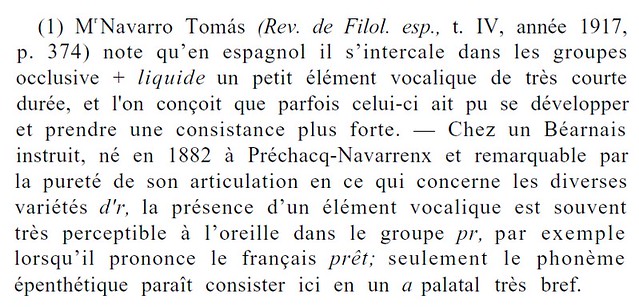
Pronunciation to "walk" in Gascon
Petit passage worth reading: it seems that the Gascon was known as the Basque phenomena epenthetic vowel.
extract Basque Phonetics.
Petit passage worth reading: it seems that the Gascon was known as the Basque phenomena epenthetic vowel.
extract Basque Phonetics.
Sunday, September 5, 2010
Sample Cover Letter Visual Merchandiser
An example of er-prosthetic in Gascon? The spelling
In its initial reluctance of r, we know that the Basque-er prefers, but it is not systematic.
Examples: 'arripayri' (Latin riparium) erripayri rather than in a medieval text, 'daRecalde' in the cadastre of Vitoria (1484). More generalized
: Arranda "annuity" arrangura "complaint"
Source: The Basque language in the Middle Ages, JB Orpustan, Editions Izpegi
Conversely, it appears that there was hesitation in Gascon. Thus the act dated from 1243 to the parish of Sainte-Eulalie de Bordeaux cites "Esteue of Errocatailhada", that is to say Stephen Roquetaillade (Hamlet Mazeres, Bazadais).
In its initial reluctance of r, we know that the Basque-er prefers, but it is not systematic.
Examples: 'arripayri' (Latin riparium) erripayri rather than in a medieval text, 'daRecalde' in the cadastre of Vitoria (1484). More generalized
: Arranda "annuity" arrangura "complaint"
Source: The Basque language in the Middle Ages, JB Orpustan, Editions Izpegi
Conversely, it appears that there was hesitation in Gascon. Thus the act dated from 1243 to the parish of Sainte-Eulalie de Bordeaux cites "Esteue of Errocatailhada", that is to say Stephen Roquetaillade (Hamlet Mazeres, Bazadais).
How To Get Married Mount And Blade
alibertine in Limousin: contradictions and discrepancies
The purpose of the spelling alibertine as designed by the vast majority of activists language is clear: unable to forge a wide Standard -Occitan dialects unify graphically in order to conceal at least the writing sometimes enormous differences between the so-called "dialects". Over time, a median pronunciation will emerge and, ultimately, a standard will emerge naturally. The spelling
alibertine has nothing to aberrant itself. The cadets have adapted it with intelligence. In Limousin, the situation is different: the Limousin Occitan linguists have simply pressed the spelling alibertine as developed for the southern Languedoc. We know the consequences: the holding of written implosive consonants dumb game to mark the main stress stamp Dantesque travesty conjugations, ... Still a bit childish desire to hide what the Limousin, namely a Romance language that shares many features with the dialects d'oil. What is less known is that the spelling as applied to alibertine Limousin not even internally consistent.
Simply take the verb "be". On the left, the proposal of Occitan. On the right pronunciation in French. (N) marks a nasalized vowel, as in French.
sei: / chey / her
: / chey /
es: / ey / wk
: / che (n) /
Setzer: / market / her
: / cabbage (n) g /
The difference is quite laughable. More importantly, the frills are unnecessary and incoherent "e" sometimes a vowel note open or closed (some would say that the Limousin does not distinguish, so it's not the OC, because this is a trait Major vocalism Occitan). "-S" notes sound / y / * ... which is written as "-i" and in no way indicates anything at the opening vowel. The form "Setz" for / market / is a nameless horror. No final note sometimes the vélarité as in "her", now nasality in other words. m final note nasalized vowel.
*: The phonetic notation /. / Pronunciation note a "French" and not the API.
This is pure madness. At other times, it's even worse in the past tense, we write fuguei which is pronounced ... / Fu'i /. Variant siguei, pronounced ... / Shi'ji /.
Let the verb "have":
Bottom-Limousin: it's almost OIL.
ai: / ey /
have: / a /
a: / o /
AVEM: / o'vè (n) /
avetz: / o'vé /
year: / o (n) /
In High Limousin:
ai: / ay /
have: / a /
a: / o /
AVEM: / AVEM / or / am /
avetz: / avey / or / a /
year: / am /
No teacher can not solve all of imprecision chart. Although this is not the only inconsistency "as" is pronounced / a /, "a" is pronounced / o /, a tonic may therefore decide in two ways ... What are the consequences of a desire to write and speak in Languedoc Limousin ... pronunciation that is lost through the written word! Respect the rules of spelling alibertine top-Limousin, it would write: I
wrong: I
wrong You're wrong: wrong is wrong He
ò wrong
We are wrong: am wrong You're wrong
: wrongly
They are wrong: wrong year
Another example: go.
vau: / vaw /
going: / va /
vai: / vey /
anam: / o'no (n) /
anatz: / o'na /
van: / vo (n) g /
How can you write "anatz" something that is pronounced / o'na /? We must at all costs in limousin amend the spelling, and perhaps endorse the spelling alibertine inspired Catalan, goes only to the Gascony and Languedoc South. Because these languages are transitional with the Ibero-Romance. And that Occitan is not ...
The purpose of the spelling alibertine as designed by the vast majority of activists language is clear: unable to forge a wide Standard -Occitan dialects unify graphically in order to conceal at least the writing sometimes enormous differences between the so-called "dialects". Over time, a median pronunciation will emerge and, ultimately, a standard will emerge naturally. The spelling
alibertine has nothing to aberrant itself. The cadets have adapted it with intelligence. In Limousin, the situation is different: the Limousin Occitan linguists have simply pressed the spelling alibertine as developed for the southern Languedoc. We know the consequences: the holding of written implosive consonants dumb game to mark the main stress stamp Dantesque travesty conjugations, ... Still a bit childish desire to hide what the Limousin, namely a Romance language that shares many features with the dialects d'oil. What is less known is that the spelling as applied to alibertine Limousin not even internally consistent.
Simply take the verb "be". On the left, the proposal of Occitan. On the right pronunciation in French. (N) marks a nasalized vowel, as in French.
sei: / chey / her
: / chey /
es: / ey / wk
: / che (n) /
Setzer: / market / her
: / cabbage (n) g /
The difference is quite laughable. More importantly, the frills are unnecessary and incoherent "e" sometimes a vowel note open or closed (some would say that the Limousin does not distinguish, so it's not the OC, because this is a trait Major vocalism Occitan). "-S" notes sound / y / * ... which is written as "-i" and in no way indicates anything at the opening vowel. The form "Setz" for / market / is a nameless horror. No final note sometimes the vélarité as in "her", now nasality in other words. m final note nasalized vowel.
*: The phonetic notation /. / Pronunciation note a "French" and not the API.
This is pure madness. At other times, it's even worse in the past tense, we write fuguei which is pronounced ... / Fu'i /. Variant siguei, pronounced ... / Shi'ji /.
Let the verb "have":
Bottom-Limousin: it's almost OIL.
ai: / ey /
have: / a /
a: / o /
AVEM: / o'vè (n) /
avetz: / o'vé /
year: / o (n) /
In High Limousin:
ai: / ay /
have: / a /
a: / o /
AVEM: / AVEM / or / am /
avetz: / avey / or / a /
year: / am /
No teacher can not solve all of imprecision chart. Although this is not the only inconsistency "as" is pronounced / a /, "a" is pronounced / o /, a tonic may therefore decide in two ways ... What are the consequences of a desire to write and speak in Languedoc Limousin ... pronunciation that is lost through the written word! Respect the rules of spelling alibertine top-Limousin, it would write: I
wrong: I
wrong You're wrong: wrong is wrong He
ò wrong
We are wrong: am wrong You're wrong
: wrongly
They are wrong: wrong year
Another example: go.
vau: / vaw /
going: / va /
vai: / vey /
anam: / o'no (n) /
anatz: / o'na /
van: / vo (n) g /
How can you write "anatz" something that is pronounced / o'na /? We must at all costs in limousin amend the spelling, and perhaps endorse the spelling alibertine inspired Catalan, goes only to the Gascony and Languedoc South. Because these languages are transitional with the Ibero-Romance. And that Occitan is not ...
Subscribe to:
Posts (Atom)