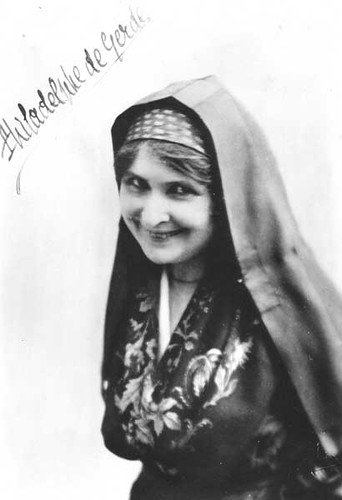
In 1892, the Philadelphia poetess bigourdane Gerde wrote:
Per No negrouso magio
Em ra balhabo noutalgio
De ... ra mour.
In the 1948 edition, "ra die" becomes "dead era. Daniel Sere include: Em ra balhabo noutalgio
De ... ra mour.
"From the outset we can see that the poem of 1892 is written in a spelling I would call" the 6-4-2 "while the 1948 version is written in a more consistent spelling, a spelling neo-Romanesque that some are calling, wrongly or rightly, as "classic." In saying this I am not advocating that spelling because it is one among other possibilities. But the fact remains that it is likely to avoid misunderstandings that. In the 1948 version is clear and unambiguous. Any pointless cogitation about Love and Death lapses.
It is not the same about the old one from 1892, when doubt remains. Although this passage is conspicuous by its obscurity (how can you yearn for death? Unless you believe in reincarnation ...) and without any desire to play the "experts" (a word much in fashion that applies too often can not), my opinion is that Philadelphia wanted to talk about "dead era" instead of "er'amor / r'amor" which is Getting in Canti, version 1948, in the form "ed amor."
Some were then able to say she had matured. Cured? Indeed, it has matured in his conservatism adopting a graphic sense of the term "conservative." Philadelphus of Gerde's understanding that the neo-medieval spellings embodied a spirit not really fit his progressive romanticism. I find it quite amusing reversal of values that has occurred late: what will become the spelling alibertine had always been the ideological weapon of the most backward renaissantistes when modern spellings, partly inspired by the French, partly heiresses changes spelling of natural language with respect to phonetic changes were proposed by the tool felibres socialistic trend, even more simply by desire to make the people understand (now an ambition to happen incongruous).
Moreover, when developing the spelling Alibert alibertine is deeply conservative and even reactionary approach that fits well as it is to exalt the language through the Ibero-Roman race which it links the people of oc (not without lamenting the "Celtic infiltration" in Limousin and Auvergne ...). In short, when Occitan write in alibertin is like when the Basques write in Basque typeface. It is primarily a matter of form before being a grammatical issue or teaching. It is a national issue.
I really do not have absolutely nothing against these arguments, debates as to what reactionary or progressive are irrelevant. I understand the aspirations of a generation that gets a Catalan-inspired national spelling and medievalist. I understand the horror of what they considered to be a bastardization of the "genius of the race" and spoke the felibres, rather emphatically. What is more harmful is to believe that the adoption of the spelling alibertine is a neutral choice, worst natural and height of hypocrisy, "progressive". I regret very much the ignorance in which lie the Occitanists today who no longer control the "background" tools of their ideological identity. When Occitanists assume with confidence that they are not in a Philadelphia
Gerde, Catholic activist, politically conservative and patriotic Petainist French, so I have nothing to complain about. Because for me, the greatest crime is not to be reactionary (even quite attractive like posture in a society that moves) is not to assume its full history. "I take everything from Clovis to the Committee of Public Hi" said Napoleon.
I finally have nothing to say about the spelling alibertine who seems intelligent, but it is a failure educational and popular. Teaching because Occitan underestimated the francization called Occitan, for whom learning the oc is impossible without extensive prior knowledge of the language. Popular because nobody has ever really recognized in the new nation whose Occitan spelling would have been the spearhead of identity (a little Basques even as some non-Basque speakers vibrate at the mere placing of a sign bilingual font Basque). In short, the South of France will never Catalonia.


0 comments:
Post a Comment